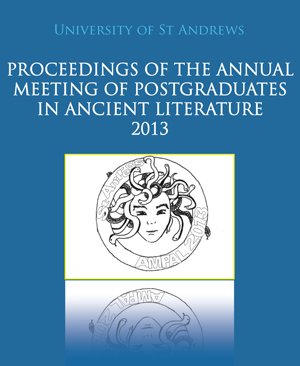
Proceedings of the Annual Meeting of Postgraduates in Ancient Literature (Ceased publication 2015)
Literature
Annual Meeting of Postgraduates in Ancient Literature (AMPAL) is an international conference in Classics.
Articles in this Journal
REAL, UNREAL AND MAGIC IN PLINY THE ELDER’S NATURALIS HISTORIA
This paper considers some reflections on healing, witchcraft and magic in Pliny the Elder’s Naturalis Historia, published around AD 77-79. As scholars of Classical antiquity, we find ourselves dealing with authors’ different ideas about re...
View Full Research
THE MANIFESTATION OF A STAR AS THE GOD ARCTURUS’ PERSONIFICATION
The figure of a divinity, in the case of Plautus’ Rudens, Arcturus, in the role of a persona prologans was very current in archaic Latin comedy. The god ― or star ― Arcturus appears to his audience as a magnificent vision: the costume worn...
View Full Research
OBSERVATIONS OF THE MARVELLOUS IN STRABO’S GEOGRAPHIKA – THE USE OF THE UNREAL FOR THE STUDY OF THE WORLD IN ANTIQUITY
In his cultural geography, Strabo gathered important, useful and amusing information concerning the structure of earth's nature, its regions and the different peoples who inhabit the world. The author was therefore also interested in myths...
View Full Research
UNREALITY INTO REALITY: HOW CHARACTERS OF OVID’S METAMORPHOSES RECEIVE AND (DON'T) ACT ON MYTHS
The inset-narrative structure of Ovid’s Metamorphoses has long been noted as a technique to allow the poet to distort both the timeline and context of his narrative. However, much less attention has been paid to the use of these stories as...
View Full Research
MONSTROUS OMENS IN HERODOTUS’ HISTORIES
Monstrous omens appear four times in Herodotus: a concubine of the king of Sardis gives birth to a lion (1.84), a mule is born with male and female genitalia (7.57), a horse gives birth to a hare (7.57) and some fish come back to life whil...
View Full Research
HEARING THE ERINYES’ VOICES: THOUGHTS ON THE ‘BINDING SONG’ (EU. 307-96)
In Eumenides, the chorus of Erinyes confronts Orestes in Athens. They surround him as he supplicates Athena, singing: Let’s dance as well as sing around him, hand in hand, and let’s reveal the terrifying power of our dark melody (Eu. 307-...
View Full Research
DREAMS, VISIONS AND EPICUREAN GODS
The Epicureans, far from being atheists, did believe in gods, and were atheistic only in the sense that they did not believe in the gods that society at large readily accepted. The only evidence that the Epicureans assert for the existence...
View Full Research
CHANGING THE SELF AND THE WORLD. THE HOMERIC HYMNS AS PATTERNS OF TRANSFORMATION AND PROGRESS
The Homeric Hymns represent the gods in a crucial and decisive moment of change in their lives, which also instigates a cosmic development. The Hymn to Demeter is built on the concept of crisis, which can be considered the first stage of p...
View Full Research
PSEUDO-DIONYSIUS ON THE PROCESSES OF NEGATION
One of the most intriguing characters of Late Antiquity is the author who wrote under the pseudonym ‘Dionysius, the Areopagite’. Although the 19th century German scholarship challenged the authenticity of the Corpus Areopagiticum, interest...
View Full Research
Top Blogs by Rating

The Digital Divide: Are We Mor...
By Sciaria

Digitalization for Delight: El...
By Sciaria
The Evolution of Knowledge in...
By Sciaria
Favorite Blog

Unlocking Life's Source Code:...
By Sciaria

Our Digital Footprint: An Anth...
By Sciaria

The Silent Saboteurs: How Micr...
By Sciaria
 Sciaria Research